
Cake Maker: Cooking Cake Games
Sweet Maker ShopStrategy
4.579.00 Reviews
- Version
- 1.3.17
- Installs
- 10.00M
- Age Rating
- Everyone
Screenshots



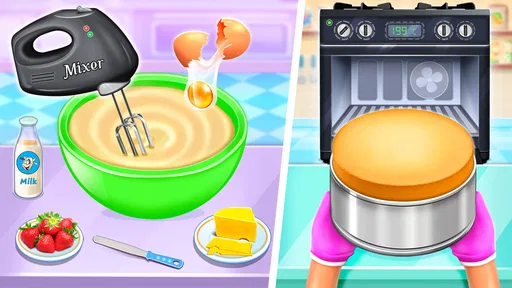




Our Review of Cake Maker: Cooking Cake Games
 Analysis by Appyee
I approached Cake Maker: Cooking Cake Games expecting a simple time-killer, and that is exactly where it works best. This is a free strategy game from Sweet Maker Shop built around preparing cakes and decorating them, with a gentle pace that makes it easy to pick up for a few minutes. It is not trying to replace a deep management game or a demanding puzzle title. Its appeal comes from the small creative decisions between starting a cake and presenting the finished result.
After spending time with it, my view is straightforward: this is a pleasant choice for younger players, casual gamers, and anyone who enjoys food-themed creative play without pressure. The experience is approachable, but its simplicity can also become its main weakness. If you want complex planning, long-term progression, or a strong competitive layer, you will probably outgrow it. If you want a friendly baking activity that feels more interactive than watching a cooking video, it has a clear place on a phone.
What the baking loop feels like in everyday play
The central appeal is the change from an unfinished cake to a decorated one. The cooking theme gives the game an immediate visual goal, while the decorating side provides the more personal part of the experience. I found that distinction useful because the preparation gives each session a recognizable beginning and the finishing touches make the result feel like my own rather than just another completed level.
The strategy label should be understood in a light, casual sense. This is not the kind of strategy game that asks me to manage a large economy, study opponents, or plan several turns ahead. The decisions are closer to choosing how to approach a baking task and how to shape the final presentation. That makes it accessible, but readers looking for serious tactical depth should adjust their expectations before installing it.
One practical strength is how naturally it fits into short breaks. I could imagine opening it while waiting for an appointment, taking a quick baking session after school, or sharing the phone with a child who wants to make something colorful. The theme is instantly understandable, so there is little need for a long explanation before someone can begin experimenting with cakes.
That simplicity also makes it a reasonable introduction to cooking games. A child who is interested in baking but is too young for a detailed simulation can understand the basic idea quickly. An adult may enjoy it as a relaxing diversion rather than as a serious game. The age rating of Everyone supports that broad audience, although younger players may still benefit from an adult keeping an eye on any purchase prompts.
The strongest part is the creative finish
For me, the decorating stage is more memorable than the cooking theme itself. Baking provides the context, but decoration is where the player gets a chance to express a preference. I tend to enjoy games more when the result visibly reflects a choice, even a small one, and this format gives the session a satisfying sense of completion.
A useful way to play is to decide on a theme before beginning. Instead of adding whatever looks appealing at the moment, I might aim for a birthday-style cake, a simple dessert, or something deliberately over-the-top. That small self-imposed goal makes the activity feel less repetitive and turns the decorating stage into a design exercise. It is one of the better ways to get more value from a straightforward game.
Another tip is to treat the first attempt as a planning pass rather than trying to create the perfect result immediately. I can notice which choices work together, remember the order that feels most comfortable, and then make a cleaner version on the next session. This approach is especially useful for children because it removes the feeling that every action has to be correct the first time.
The game also works well as a shared activity. One person can handle the preparation while another chooses the visual direction, then they can swap roles. That makes the experience more social than its basic format might suggest. It is not a multiplayer strategy game, but passing the device around and discussing the cake can make a short session feel like a small collaborative project.
Why the low-pressure design matters
Many cooking games push urgency, timers, customer demands, or increasingly complicated orders. This one is more comfortable for players who dislike that kind of pressure. The cake theme feels playful rather than stressful, and the decorating focus gives the player room to enjoy the process instead of constantly reacting to a countdown.
That makes it particularly suitable for a calm routine. I would recommend it for a short wind-down session when I want something interactive but do not want to concentrate on a difficult puzzle. It can also be a better choice for a child who becomes frustrated by failure-heavy games, because the subject matter is familiar and the goal is easy to understand.
The trade-off is that relaxed play does not automatically create lasting variety. Once the novelty of making cakes fades, the experience depends heavily on how much enjoyment the player gets from repeating the cooking-and-decoration pattern. I found that it is best used in small sessions rather than treated as a game that needs to occupy an entire afternoon.
Where it differs from other cooking and strategy games
Compared with restaurant-management games, this title appears much more focused on the individual cake. It is not the right substitute for someone who wants to run a busy kitchen, balance resources, serve a queue of customers, or make decisions across a large campaign. Those alternatives usually offer more systems to master, while this game is easier to understand and less demanding.
Compared with baking simulators that emphasize realism, it also favors accessibility over technical detail. A realistic simulator may be more satisfying for a player who wants precise recipes and a stronger sense of culinary procedure. Here, the pleasure is more visual and playful. I would choose this game for creative cake making, not for learning how real baking works.
Against match-three cooking games, its advantage is the feeling of making an object rather than simply clearing a board. The disadvantage is that it may not provide the same constant stream of quick challenges. Players who enjoy rapid scoring, combo chains, and highly structured levels may find a puzzle-based alternative more engaging over time.
This comparison helped me understand the game’s proper audience. It sits between a toy-like creative activity and a casual cooking game. That middle ground is appealing when I want something friendly and uncomplicated, but it is less convincing if I am searching for a strategy experience with meaningful consequences.
The meaningful limitation: simplicity can turn into repetition
The main weakness is not that the game is easy; the easygoing approach is part of its charm. The issue is that players who need constant new objectives may find the core routine narrow. Cooking a cake and decorating it is a clear premise, but a clear premise needs enough variation to stay fresh for people who play for long stretches.
I would therefore avoid presenting it as a deep strategy title. The category helps explain its decision-making element, but the experience is better understood as casual creative play with light planning. That distinction matters because a person downloading it for advanced tactics could feel disappointed even if the game itself is functioning exactly as intended.
There is also a practical trade-off in the free model. The game costs nothing to start, while optional in-app purchases are priced at $2.99 per item. That makes trying it easy, but families should still establish a simple rule before handing over a device: children can play freely, but purchases require permission. The safest approach is to review the purchase settings on the device and make expectations clear in advance.
I also think the game is less suitable for someone who wants a completely uninterrupted experience. Even when optional purchases are not necessary, free mobile games can make players more aware of progression limits or available extras. For me, that is not a reason to dismiss it, but it is a reason to decide whether the basic loop is enjoyable enough without spending anything.
Another limitation is that the game’s appeal depends strongly on presentation and personal creativity. A player who does not care about decorating or food themes may not find enough substance elsewhere. Someone who prefers action, exploration, competition, or narrative will be better served by a different genre. The cake setting is not just a skin over a strategy game; it is the entire reason to be here.
Who should install it
I would recommend it first to casual players who want a friendly baking game that can be understood quickly. It is also a good fit for children and families looking for a simple activity to share, especially when the goal is to create something colorful rather than win against another player.
It may suit you if you enjoy decorating games but do not want the pressure found in restaurant rush titles. It is a reasonable pick for short breaks, quiet evenings, and moments when I want a game that does not demand a complicated tutorial before becoming enjoyable.
The technical entry point is also fairly broad. The game supports Android devices running version 8.0 or later, so owners of older compatible phones may still be able to try it. Its current version is 1.3.17, and that is worth checking against the version shown on your device before downloading, particularly if you are using an older handset.
The game has clearly reached a substantial audience, with over ten million installs and a 4.5 average from around seventy-eight thousand ratings. Those figures do not guarantee that every player will enjoy the same style, but they do suggest that the basic concept has connected with many people. I would read that as evidence of broad accessibility rather than proof of deep strategy.
It is less appropriate for players who want a serious cooking simulation, a competitive strategy game, or an experience built around complex progression. I would also skip it if I know I lose interest quickly in repeating a visual customization loop. In those cases, a restaurant-management game, a recipe-focused simulator, or a puzzle title would probably offer a better match.
Small habits that make the experience better
My first recommendation is to play with a purpose. Choose a cake style before starting, whether that means keeping the design simple or deliberately making it extravagant. This gives the session a creative constraint and helps prevent the decorating stage from feeling like a sequence of random taps.
My second recommendation is to use it as a shared screen activity rather than assuming it has to provide a long solo campaign. A parent and child can discuss which design looks best, or two friends can challenge each other to create different interpretations of the same cake. The game becomes more interesting when the choices are part of a conversation.
My third recommendation is to keep spending separate from enjoyment. Since the game is free and purchases are optional items priced at $2.99 each, I would first decide whether the basic baking loop is satisfying on its own. If it is, any later purchase becomes a conscious choice rather than something made simply because the game has been installed.
Finally, I would keep sessions short if repetition starts to show. This is not a criticism of the game’s intended pace. In fact, its strongest use is as a compact activity. Returning to it occasionally can preserve the pleasant feeling of making a cake, while forcing long sessions may make its limited scope more obvious.
My verdict on Cake Maker: Cooking Cake Games
Sweet Maker Shop has made a welcoming casual strategy game with a clear identity. The combination of cake preparation and decoration is easy to understand, approachable for an Everyone audience, and flexible enough for solo or shared play. I especially like the way a simple personal theme can turn an ordinary session into a small design challenge.
Its weaknesses are equally clear. The game does not offer the depth of a management simulator or the constant challenge of a competitive strategy title, and the repeated baking pattern may not hold every player’s attention indefinitely. The optional purchases also mean families should set boundaries before children play.
Still, I think the game succeeds when judged by what it actually offers: a relaxed cake-making activity with light strategy and room for personal decoration. It is free to try, runs on Android 8.0 or later, and has attracted a large audience without needing a complicated premise. I would recommend it to casual players, children, and anyone who wants a cheerful creative break. I would not recommend it to players searching for realism, tactical depth, or a substantial long-term campaign.
My final advice is simple: install it if the idea of designing cakes sounds enjoyable, and approach it as a short creative game rather than a full strategy adventure. With that expectation, its simplicity becomes a strength instead of a disappointment. Cake Maker: Cooking Cake Games is at its best when I give myself a small decorating goal, enjoy the process, and stop before the familiar routine starts to feel like work.
Verdict
Strengths of Cake Maker: Cooking Cake Games
- Simple controls make it easy for children to start playing.
- Bright visuals and cake designs create an appealing cooking experience.
- Many decorating tools encourage creativity and personal expression.
- Short activities work well for quick, casual gaming sessions.
- Offline play is convenient when an internet connection is unavailable.
Limitations of Cake Maker: Cooking Cake Games
- Gameplay can become repetitive after completing several cake recipes.
- Some decorations or features may require in-app purchases.
- Frequent ads can interrupt the cooking and decorating flow.
- The game offers limited challenge for older or experienced players.
- Privacy and ad settings should be checked before allowing children to play.
Similar Picks in This Category
View All
Clash of Clans
Supercell4.5

Plants vs. Zombies™
ELECTRONIC ARTS3.7

Lords Mobile: Kingdom Wars
IGG.COM4.5

Clash Royale
Supercell4.4

State.io — Conquer the World
CASUAL AZUR GAMES4.1

Car Driving School : Car Games
Spark Game Studios3.9
Frequently Asked Questions
What is Cake Maker: Cooking Cake Games?
Cake Maker: Cooking Cake Games is a casual cooking game centered on preparing and decorating cakes. During the experience, you typically choose ingredients, mix batter, bake the cake, add frosting, and finish it with decorations. The simple controls and colorful presentation make it suitable for players who enjoy relaxed, creative games rather than challenging strategy or fast-paced action.
How do you play Cake Maker: Cooking Cake Games?
Gameplay usually follows a step-by-step cake-making process. You select ingredients, combine them in the correct order, use kitchen tools, place the mixture in an oven, and decorate the finished cake with icing, toppings, colors, and other accessories. The controls are designed to be easy to understand, so younger players can participate without needing previous cooking-game experience.
Is Cake Maker: Cooking Cake Games suitable for children?
The game is generally designed with children and casual players in mind, thanks to its bright visuals, straightforward tasks, and non-violent cooking theme. However, parents should still review the app’s age rating, advertising settings, and privacy information before installation. Depending on the version and device, the game may include optional purchases or advertisements that younger children could tap accidentally.
Does Cake Maker: Cooking Cake Games require an internet connection?
Some parts of Cake Maker: Cooking Cake Games may work without a constant internet connection, especially the basic cooking and decorating activities. Nevertheless, online access can be required for advertisements, analytics, updates, restoring purchases, or loading additional content. Because requirements may vary between Android and iOS versions, it is best to test the game after installation rather than assuming every feature will be available offline.
Is Cake Maker: Cooking Cake Games free to download and play?
The game may be available as a free download, but free access does not always mean that every feature is included. Advertisements, locked decorations, extra ingredients, or optional in-app purchases can appear during play. Before downloading, check the official store listing for the current pricing, purchase details, and subscription information. Parents should also enable purchase restrictions if children use the device.
Play our best games!


